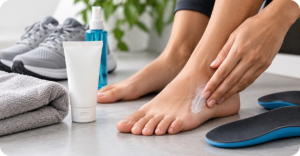
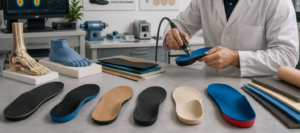
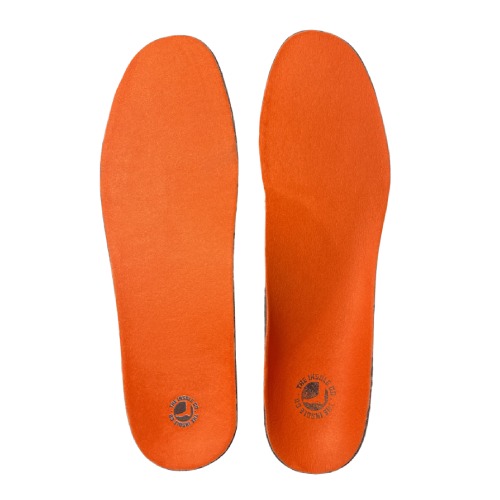
Custom insoles are shoe inserts made specifically for your feet. Unlike the flat foam inserts that come with most footwear, custom insoles are built from a scan, impression, or mould of your foot.
Because they match your exact foot shape, arch height, and pressure points, they support your feet the way a generic insert never can. They are also called custom made foot insoles or custom orthotic insoles, depending on whether they are designed for comfort or to correct a specific foot problem
How Do Custom Insoles Work?
Custom insoles work by redistributing pressure and supporting your foot in its natural position. The process usually looks like this:
- Your foot is scanned or an impression is taken to map its shape and pressure points
- An orthotist/foot specialist reviews your arch type, gait, and any pain areas
- The insole is manufactured to match that data, often using 3D printing or CNC milling
- You wear them inside your regular shoes, replacing the factory insole
Once in your shoe, the insole spreads your body weight evenly across the foot instead of letting it concentrate on the heel or ball. This reduces strain on the foot, ankle, knees, and lower back.
Custom Insoles vs Regular Insoles
Regular insoles are made for an average foot. Custom insoles are made for your foot. That single difference changes everything about how they perform.
Feature | Regular Insoles | Custom Insoles |
Fit | Generic, one shape for all | Matched to your foot |
Arch support | Fixed, often too low or too high | Built for your exact arch |
Pain relief | Mild cushioning only | Targets your specific pressure points |
Lifespan | 3 to 6 months | 1 to 3 years on average |
Cost | Low upfront | Higher upfront, better long term value |
A 8 week study in symptomatic flatfoot patients found that customized 3D printed insoles reduced load on the metatarsals by redistributing it to the mid-foot area, thereby reducing foot lesions and performed better than pre fabricated insoles.
Regular insoles are fine for adding a bit of softness. But if you have flat feet, high arches, heel pain, or you stand for long hours, custom fit insoles solve the problem instead of padding over it.
Key Benefits of Custom Made Insoles
The main benefits of custom made insoles are:
- Pain relief: They reduce heel pain, arch pain, and discomfort from conditions like plantar fasciitis
- Better posture and alignment: Supporting the foot correctly improves how your ankles, knees, and hips line up
- Even pressure distribution: Useful for diabetics and anyone prone to calluses or pressure sores. “A systematic review of clinical studies found that customized insoles significantly reduce peak plantar pressure in people with diabetic foot syndrome, which is key to preventing ulcers.”
- Less fatigue: Your feet tire slower when they are properly supported
- Longer lasting: Quality materials hold their shape far longer than off-the-shelf inserts
How Custom Arch Support Helps Foot Alignment
Your arch acts as the shock absorber of your body. When it collapses (flat feet) or is too rigid (high arches), the impact of every step travels up the leg incorrectly.
Custom arch support holds the arch at its ideal height for your foot. This keeps the ankle in a neutral position, which in turn keeps the knees and hips aligned. Many people who get insoles for foot pain are surprised when their knee or lower back pain improves too. That is alignment at work.
Who Should Consider Custom Foot Insoles?
Custom foot insoles are worth considering if you fall into any of these groups:
- People with flat feet, high arches, or plantar fasciitis
- Diabetics who need pressure distribution to prevent foot complications
- Anyone who stands or walks for 6+ hours a day for work
- Runners and athletes dealing with recurring foot, shin, or knee pain.
- People recovering from foot or ankle injuries
- Anyone whose regular insoles wear out quickly or never feel right
If your feet feel fine and you have no pain or alignment issues, a good quality regular insole may be enough.
Using Custom Shoe Insoles for Daily Comfort
Custom shoe insoles are not just for medical problems. Many adults as well as kids use them simply because their day involves a lot of standing and being on the move.
A few practical tips:
- Wear them gradually at first. Start with 2 to 3 hours a day and increase over a week
- Move them between shoes if they fit, though a dedicated pair per shoe works best
- Keep them dry and follow a proper cleaning routine with a damp cloth, never soak them
- Replace them when the support starts to feel flat, usually after 1 to 3 years
Mild soreness in the first few days is normal as your feet adjust to proper support.
How to Choose the Right Pair
Not all custom insoles are made the same way. Here is what to look for:
- A proper foot assessment: The best custom insoles start with a 3D scan or detailed impression, not just a quick foot tracing
- Expert involvement: A podiatrist or trained specialist should review your foot type and concerns
- Purpose-built design: Insoles for running, standing work, and diabetic care are built differently. Be clear about your use case
- Quality materials: EVA, polypropylene, and medical grade foams last longer and perform better
- Adjustment support: A good provider will refine the insole if it does not feel right after the break-in period
Are Custom Fit Insoles Worth It?
For most people with foot pain, alignment issues, or long standing hours, yes. Custom fit insoles cost more upfront than store-bought inserts, but they last 3 to 5 times longer and actually address the cause of discomfort rather than masking it.
Think of it this way. A generic insole costs less but gets replaced every few months and never quite fits. A custom pair is a one-time investment that works precisely for your feet, often for years. If foot pain affects your daily life or work, the value is clear.
If you have healthy, pain-free feet, you can likely skip them for now.
Frequently Asked Questions
1. How long do custom insoles last?
Most custom insoles can last 10 to 12 months depending on usage, materials, and how active you are.
2. Can I move custom insoles between different shoes?
Yes, as long as the shoes are a similar size and style, though a dedicated pair per shoe gives the best fit.
3. How long does it take to get used to custom insoles?
Most people adjust within 1 to 2 weeks of gradual daily wear.
4. Do custom insoles help with knee and back pain?
Yes, by correcting foot alignment they often reduce strain on the knees, hips, and lower back.
5. Are custom insoles covered by insurance?
Some health insurance plans cover them when prescribed for a medical condition, so check with your provider.