Your feet carry your entire body weight through every step you take. On a typical day, that can add up to thousands of steps. Over time, small problems in the way your feet move or align can create real pain, not just in your feet, but in your knees, hips, and lower back too.
This is where orthotics come in.
Orthotics are shoe inserts designed to support the structure of your foot, correct the way you walk, and reduce the stress that builds up in the wrong places. They are one of the most widely used non-surgical interventions for foot pain, and for good reason. When used correctly, they can make a significant difference to how comfortable and stable you feel on your feet.
This guide explains how orthotics work, how custom orthotics differ from standard insoles, and how long it typically takes to feel results.
What Are Orthotics?
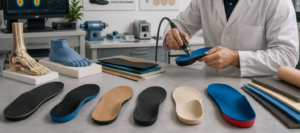
Orthotics are inserts placed inside your shoes to support, align, or cushion your feet. They sit between the sole of your shoe and the bottom of your foot, directly influencing how your foot behaves when you stand, walk, or run.
They are not the same as the foam pads you find at a pharmacy. While those off-the-shelf insoles offer basic cushioning, orthotics are specifically designed to address the mechanics of your foot.
There are two broad categories:
- Prefabricated orthotics are made in standard sizes and shapes. They are available over the counter and are suitable for mild discomfort or general arch support.
- Custom orthotics are made from a detailed assessment of your individual foot structure, pressure patterns, and gait. They are designed to match your specific needs.
Orthotics can be soft and cushioned, semi-rigid, or firm and rigid, depending on what the foot needs. Your condition, activity level, and the type of footwear you use all influence which type is appropriate.
How Do Orthotics Work?
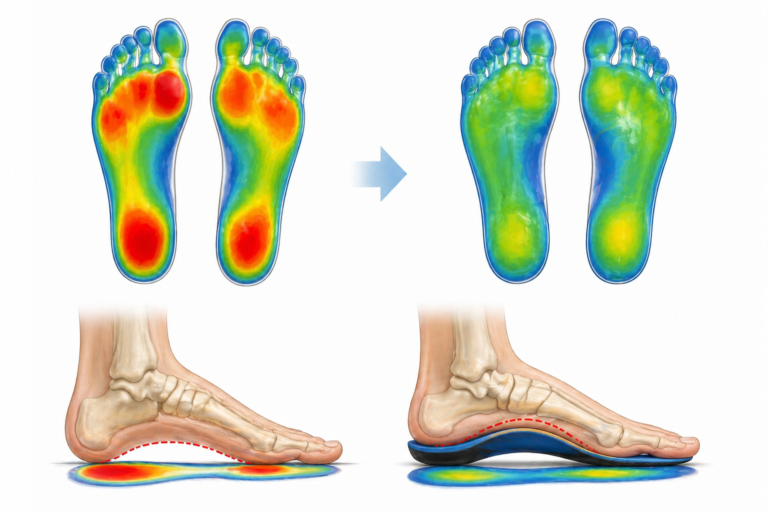
Orthotics work by changing the mechanical environment inside your shoe. They influence how forces travel through your foot and into the rest of your body with every step.
Here is what that looks like in practice:
1. Pressure Redistribution
When you stand or walk, pressure is not always distributed evenly across your foot. If you have flat feet, the inner arch collapses and concentrates load on the wrong areas. If you have high arches, pressure builds under the heel and ball of the foot.
Orthotics spread this pressure more evenly across the entire surface of the foot. By doing this, they reduce the overloading of specific structures like tendons, ligaments, and joints.
2. Alignment Correction
Your feet are the base of your entire skeletal alignment. When they roll inward (overpronation) or outward (supination), the effects travel upward. Misaligned feet can contribute to knee pain, hip tightness, and lower back discomfort.
Orthotics correct this by guiding the foot into a more neutral position. They gently adjust how your foot contacts the ground so that your ankle, knee, and hip can work in better alignment.
3. Arch Support
The arch of your foot acts as a natural shock absorber. When the arch is too low or too high, it cannot perform this function efficiently.
Orthotics support the arch from underneath. For flat feet, they lift the arch and reduce the strain on the plantar fascia and tibial tendon. For high arches, they fill the gap under the arch and distribute load more broadly.
4. Shock Absorption
Every time your foot strikes the ground, your joints absorb an impact force. Repeated over thousands of steps, this stress adds up.
Many orthotics use materials that absorb and dissipate this force before it reaches the joints. This is particularly useful for people who stand for long hours, run regularly, or have conditions like arthritis that make joints more sensitive to impact.
5. Offloading Painful Areas
For conditions like diabetic foot, plantar fasciitis, or heel spurs, the goal is often to reduce direct pressure on a specific area. Orthotics can be designed with cut-outs, softer zones, or additional padding in targeted locations to take pressure away from inflamed or damaged tissue.
How Do Custom Orthotics Work?
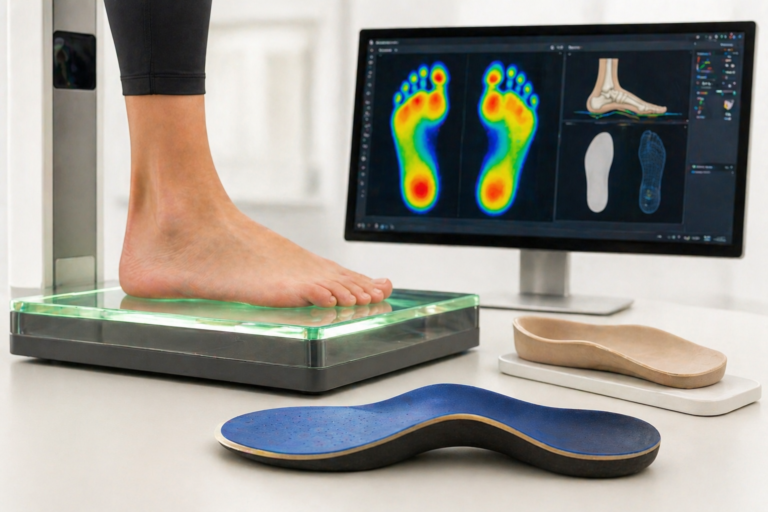
Custom orthotics work on the same mechanical principles as standard insoles, but they are built around the exact shape and movement pattern of your foot. This makes them significantly more precise.
1. The Assessment Process
The process begins with a detailed foot assessment. This typically involves:
- Examining your foot structure at rest and under load
- Analysing how you walk (gait analysis)
- Identifying areas of high pressure or abnormal movement
- Reviewing your footwear and daily activity levels
- Understanding your specific pain points or diagnosis
A 3D scan or pressure mapping test is often used to capture the exact contours of your foot and how load is distributed when you stand and move.
2. The Design Stage
Once the assessment data is collected, the orthotic is designed to address what was found. This means the arch height, heel cup depth, cushioning zones, and rigidity are all tailored to you. No two custom orthotics are identical because no two feet are.
Materials are selected based on your needs. Someone with diabetes who needs offloading and sensitivity will need a very different material than an athlete who needs stability and energy return.
How They Differ from Standard Insoles
The key difference is specificity. A prefabricated insole is shaped for a general foot and offers general support. It may help with mild discomfort, but it cannot correct a specific biomechanical issue.
Custom orthotics are designed around your actual foot measurements and movement data. They address the root cause of your problem rather than just adding cushioning over it.
For conditions like plantar fasciitis, flat feet, overpronation, or diabetic foot complications, custom orthotics are clinically more effective than off-the-shelf alternatives because the support is placed exactly where it is needed.
| Feature | Custom Orthotics | Standard Insoles |
|---|---|---|
| Fit | Built to your exact foot shape | Generic sizing |
| Assessment Required | Yes, includes gait and pressure analysis | No |
| Addresses Biomechanical Issues | Yes, corrects specific problems | Limited |
| Materials | Chosen based on your condition and activity | Fixed, general-purpose |
| Effectiveness for Chronic Conditions | Higher | Lower |
| Cost | Higher upfront | Lower upfront |
| Best For | Specific diagnoses, persistent pain | Mild discomfort, general comfort |
How Long Do Orthotics Take to Work?
This is one of the most common questions people ask after getting orthotics, and the answer depends on several factors.
General Timeline
- First 1 to 2 weeks: Most people notice an adjustment period. Your feet, ankles, and leg muscles are adapting to a new way of distributing load. Some mild soreness or fatigue is normal during this phase.
- 2 to 6 weeks: Many people begin to notice reduced pain and improved comfort. For mild conditions, this may be when the main benefit is felt.
- 6 to 12 weeks: For chronic or more complex conditions like long-standing plantar fasciitis, arthritis-related foot pain, or significant overpronation, meaningful improvement typically shows up within this window.
- 3 to 6 months: For conditions involving postural correction or structural changes in how you walk, the full benefit may take several months to become apparent. This is because your muscles and joints are gradually adapting to better alignment.
| Timeframe | What to Expect |
|---|---|
| Week 1 to 2 | Adjustment period; mild soreness or fatigue is normal |
| Week 2 to 6 | Reduced pain and improved comfort; mild conditions may feel full benefit |
| Week 6 to 12 | Meaningful improvement for chronic conditions like plantar fasciitis or overpronation |
| Month 3 to 6 | Full benefit for postural correction and structural gait changes |
Factors That Affect How Quickly Orthotics Work
The severity of your condition. Someone with mild arch pain will feel relief faster than someone managing a chronic tendon issue or significant flat feet.
How consistently you wear them. Orthotics work cumulatively. Wearing them only occasionally slows progress. Consistent daily use produces faster and more lasting results.
Your footwear. Orthotics work best in shoes with enough depth and structure to accommodate them. Wearing them in unsupportive or shallow shoes limits their effectiveness.
Your activity level. People who are more active place greater and more frequent load on their feet, which can speed up the adaptation process. However, high impact activity without adequate rest can also slow recovery if there is an acute injury involved.
Whether you are combining orthotics with other treatment. Orthotics often work best as part of a broader plan that may include strengthening exercises, physiotherapy, or footwear changes. If the underlying cause is also being addressed, orthotics tend to work faster.
The fit and quality of the orthotic. A poorly fitted prefabricated insole may not produce results at all. A well-assessed custom orthotic that matches your foot precisely will typically work faster and more effectively.
Benefits of Orthotics
When used appropriately, orthotics offer a range of benefits that go beyond just foot comfort.
- Pain relief in the heel, arch, ball of the foot, and toes
- Reduced knee, hip, and lower back pain linked to poor foot alignment
- Improved posture by correcting the base of your alignment
- Better walking endurance, particularly for people who stand or walk for long hours
- Reduced fatigue in the feet and legs at the end of the day
- Support for recovery from injuries like plantar fasciitis, tendinitis, or stress fractures
- Prevention of worsening in progressive conditions like bunions or flat feet
- Protection for diabetic feet by reducing pressure points that can lead to ulcers
- Improved stability for older adults or anyone with balance concerns
When Should You Consider Orthotics?
Orthotics are not only for people with severe foot conditions. They are useful across a wide range of situations.
You might benefit from orthotics if you:
- Experience heel pain, especially in the morning or after periods of rest
- Have arch pain or notice your arches flattening when you stand
- Feel foot fatigue or pain after standing or walking for extended periods
- Notice uneven wear patterns on your shoes, which can indicate overpronation or supination
- Have been diagnosed with plantar fasciitis, flat feet, high arches, arthritis, or diabetes
- Experience recurring knee, hip, or lower back pain without a clear injury cause
- Are returning to activity after a foot or ankle injury
- Are pregnant and experiencing new foot discomfort due to weight and postural changes
- Are an athlete looking to reduce injury risk or improve biomechanical efficiency
If any of these apply to you, a foot assessment is a good starting point. A specialist can evaluate your foot type, gait, and symptoms to determine whether orthotics are appropriate and what kind would suit your needs best.
Conclusion
Orthotics work by improving the mechanical conditions inside your shoe. They redistribute pressure, support the arch, correct alignment, and absorb shock. Done well, this adds up to less strain on the structures that are being overworked, and more comfort in the ones that have been compensating.
Custom orthotics take this a step further by matching the intervention to the exact shape and movement pattern of your foot. The process is more detailed, but so are the results.
How quickly they work depends on your condition, your consistency, and the quality of the fit. For most people, noticeable improvement comes within the first few weeks, with full benefit building over months of regular use.
The goal of orthotics is not to permanently correct your feet. It is to support them well enough that you can move through your day with less pain and more confidence in every step you take.