With hundreds of insole options now on Amazon, Flipkart, and pharmacy shelves across India, most buyers pick by price or star rating — not by foot type. The wrong size or type won’t just fail to help; it can worsen heel and arch pain from daily walking, standing jobs, or commuting on hard floors. Here’s how to get both right.
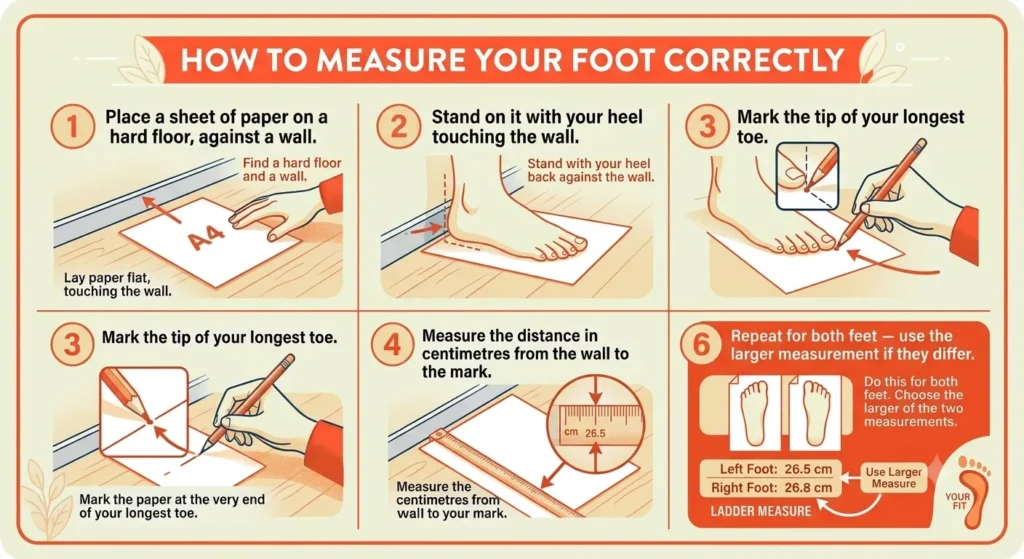

Step 1: Measure Your Foot Correctly
Don’t rely on your shoe size alone — shoe sizing varies by brand, and insoles need to match your actual foot length.
- Place a sheet of paper on a hard floor, against a wall.
- Stand on it with your heel touching the wall.
- Mark the tip of your longest toe.
- Measure the distance in centimetres from the wall to the mark.
- Repeat for both feet — use the larger measurement if they differ.
Match this to your insole brand’s size chart, which is usually listed in cm alongside India/UK shoe sizes. If you fall between sizes, or the insole is a trim-to-fit type, size up and trim from the toe area using the printed guideline — never trim from the heel, as it will throw off arch and heel-cup alignment.
Fixed-size vs. trim-to-fit: Fixed-size insoles hold their structure better since the arch and heel cup are precision-molded. Trim-to-fit insoles offer more flexibility across shoe types but should only be trimmed at the marked lines.
Step 2: Identify the Right Type for Your Condition
Match the insole to what you’re actually dealing with — not the other way around. Podiatrists generally sort insoles by three parameters: arch height, primary complaint, and rigidity of the shell.
Condition / Need | Insole Type | Key Feature |
Flat feet / low arch | Firm arch support, angled heel post | Controls overpronation (feet rolling inward) |
High arch | Higher-volume arch support | Prevents underpronation and lateral strain |
Plantar fasciitis | Semi-rigid shell with deep heel cup | Stabilizes rearfoot, cushions heel strike |
Diabetic foot | Extra-depth, pressure-redistribution insoles | Reduces ulceration risk at pressure points |
Standing all day | Cushioning/comfort insoles | Shock absorption over long wear |
Running / sports | Shock-absorbing, semi-rigid insoles | Reduces impact-related injury risk |
A key distinction from podiatric guidance: flexible flat feet usually respond well to off-the-shelf insoles, but a rigid flatfoot or a foot that only collapses under load may need a custom orthotic assessed by a podiatrist rather than a store-bought insert.
For diabetic patients specifically, footwear and insole choices should be matched to ulceration risk category, as outlined in the International Working Group on the Diabetic Foot’s guidance on footwear and offloading. Patients with prior ulcers, significant neuropathy, or foot deformity are advised toward custom therapeutic footwear rather than off-the-shelf insoles, per a joint clinical practice guideline from the Society for Vascular Surgery and the American Podiatric Medical Association. This isn’t a decision to make from a product listing — it needs a professional assessment.
Step 3: Check the Rigidity, Not Just the Cushioning
Cushioning and support are not the same thing. A soft insole can feel comfortable in-store and still fail to correct alignment. As podiatrist guidance on shopping for supportive insoles points out, a cushioned but flexible insole won’t provide real structural support, infact, semi-rigid shells are what actually hold the arch and heel in place during walking.
Step 4: Match Material to Climate and Use
- EVA foam – lightweight, decent shock absorption, moderate durability. Common in mid-range insoles.
- Gel – best shock absorption, heavier, retains heat (a consideration in Indian summers/humidity).
- Memory foam – best initial comfort, softens over time, least corrective support.
- Cork / semi-rigid composite – most durable structural support, least cushioning.
For humid or high-sweat conditions, look for insoles with moisture-wicking top layers regardless of the base material — this matters more in India’s climate than in most Western sizing guides you’ll find online.
Step 5: Confirm Shoe Compatibility
Insoles should sit flush without bunching, rolling, or crowding your toes. According to podiatrist-reviewed insole fit guidance from CNN Underscored, an insole that shifts or rolls up inside the shoe is the wrong fit regardless of how correct the arch support feels when standing still. Also note: insoles behave differently in formal shoes, sports shoes, and open footwear like sandals — a trim-to-fit sports insole will rarely transfer well into a formal shoe’s narrower toe box.
When to Stop Guessing and See a Podiatrist?
If pain persists after 4–6 weeks of consistent use of a correctly sized, correctly matched insole, the issue is likely structural and beyond what an off-the-shelf insert can fix — that’s a signal to get a biomechanical assessment rather than trying another product.